
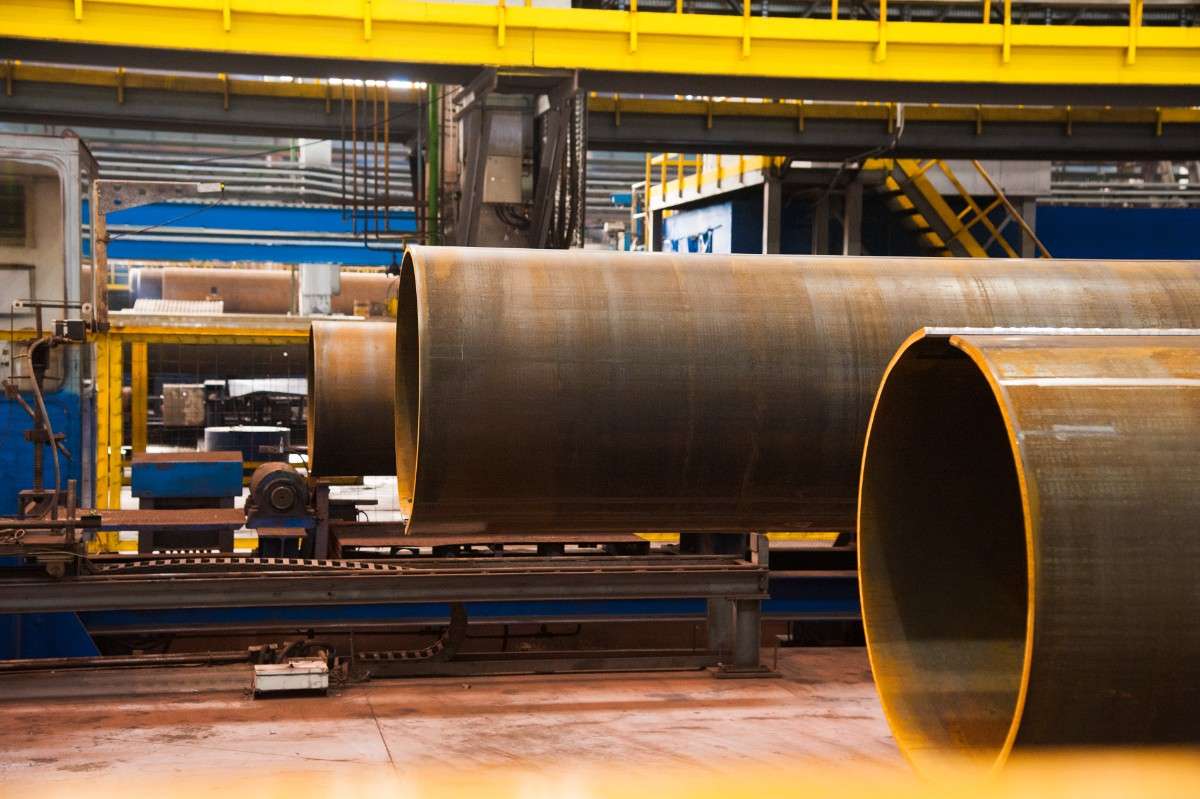
Summary: Seamless line pipe is manufactured without a weld seam, making it the specified choice for high-pressure, high-temperature, and structurally demanding pipeline applications. This guide covers how SMLS pipe is manufactured, how it compares to ERW and DSAW, the grades and standards that govern it, its primary applications, and how to determine when seamless is the right specification for your project.
Not every pipeline application is created equal. A low-pressure gas gathering lateral and a high-pressure transmission line running through a populated area are both pipelines, but they don’t belong in the same pipe.
The manufacturing method, grade, and wall thickness that serve one well can be inadequate for the other. That’s the core reason seamless line pipe exists as a distinct product category, and why specifying it correctly matters as much as any other decision on a premium pipeline project.
This guide explains what seamless line pipe is, how it’s made, where it belongs, and where it doesn’t, so the specification decision gets made on engineering merit, not assumption.
What Is Seamless Line Pipe?
Seamless line pipe is a carbon steel pipe produced without a longitudinal weld seam, extruded from a solid steel billet through a piercing and rolling process that creates the pipe’s hollow form entirely from one piece of material. Because there is no weld, there is no heat-affected zone, no seam to test, and no localized variation in material properties along the pipe’s length.
That distinction matters in high-pressure, high-temperature, and cyclic loading applications where a weld seam represents a potential performance variable. SMLS line pipe is manufactured to ASTM A106B/C for elevated temperature service, ASTM A53 Grade B for general purpose applications, and API 5L grades from GR B through X65 for hydrocarbon gathering and transmission, the standards that govern the most demanding pipeline service conditions.
How Seamless Pipe Is Manufactured
The process begins with a solid cylindrical steel billet, heated to forging temperature and driven over a piercing mandrel to create the initial hollow tube. That tube is then passed through a series of rolling mills that reduce it to the specified outside diameter and wall thickness with precise dimensional control.
After rolling, seamless line pipe typically undergoes normalizing or heat treatment to relieve internal stresses introduced during forming and to achieve the mechanical properties of yield strength, tensile strength, and impact toughness required by the applicable standard. Because no welding is involved at any stage, the material properties are uniform throughout the pipe wall and along the full length of each joint.
Quality control in SMLS production includes dimensional verification, hydrostatic testing, ultrasonic inspection of the pipe body, and chemical and mechanical testing against the mill test report. Every joint that leaves the mill to a reputable distributor like B&W Pipe ships with certified MTRs confirming compliance.
Seamless Pipe Specifications and Grades
B&W Pipe carries SMLS line pipe from 2″ to 26″ OD with wall thicknesses ranging from 0.375″ to 3.00″, covering the full range of standard and heavy-wall applications.
ASTM A106B/C is the primary specification for seamless pipe in elevated temperature service, process piping, refineries, power plants, and steam systems where carbon steel must perform reliably above the temperature range that ERW pipe is rated for. A106C provides higher yield and tensile strength minimums than A106B for more demanding conditions.
API 5L GR B through X65 governs seamless line pipe for hydrocarbon gathering and transmission. B&W Pipe’s SMLS product line covers this full grade range, providing the pressure capacity and material consistency that high-pressure gas and liquid pipeline service requires.
Pressure ratings in SMLS line pipe are calculated from OD, wall thickness, and the specified minimum yield strength of the grade, applied against the appropriate design factor under ASME B31.8 for gas service or B31.3 for process piping. Because there is no weld seam efficiency factor to apply, seamless pipe achieves its full calculated pressure rating, a meaningful advantage over welded pipe in applications where every psi of design pressure matters.
The Real Differences Seamless vs. Welded Pipe
| Factor | SMLS | ERW | DSAW |
| Weld Seam | None | Single longitudinal seam | Double submerged arc weld (ID and OD) |
| Pressure Performance | Full rated capacity, no seam efficiency factor | Seam efficiency factor applied in some codes | Seam efficiency factor applied |
| Size Range | 2″ – 26″ OD | 2-3/8″ – 26″ OD | 16″ – 60″ OD |
| Wall Thickness | Up to 3.00″ WT | Up to 0.844″ WT | Up to 2.00″ WT |
| Cost | Highest | Lowest | Mid-range |
| Lead Time | Longer for niche sizes | Best availability | Moderate |
| Best For | High-pressure, high-temp, cyclic service | General gathering and distribution | Large-diameter transmission and structural |
The cost premium for SMLS line pipe over ERW is real, typically 30 to 60 percent higher depending on size, grade, and market conditions. That premium is justified when the application demands it. It is not justified when ERW at the appropriate grade and wall thickness meets every pressure, temperature, and code requirement. Over-specifying seamless where ERW performs adequately adds material cost without adding performance.
Primary Applications for Seamless Line Pipe
High-Pressure Transmission Lines: Where operating pressure and location class push design requirements past what ERW’s seam efficiency factor allows at practical wall thicknesses, SMLS line pipe is the specified solution. No seam means no efficiency reduction in the pressure calculation.
Subsea and Offshore Pipelines: Extreme external pressure, temperature cycling, and the consequences of a failure in a subsea environment make the uniform material properties of seamless pipe the correct specification for offshore and subsea applications.
Power Plant Steam Lines: ASTM A106B/C seamless pipe is the standard for high-temperature steam service in power generation. The absence of a weld seam eliminates the primary failure risk in thermal cycling environments.
Piling Applications: Where structural load-bearing integrity is non-negotiable, and wall thickness demands exceed what ERW can produce, seamless heavy-wall pipe delivers the material consistency that structural engineers require.
Chemical and Petrochemical Transport: Process fluids in chemical and petrochemical service can be corrosive, high-temperature, or high-pressure, often all three simultaneously. SMLS line pipe’s uniform wall and absence of a heat-affected zone make it a reliable specification for these demanding conditions.
Specialty Gas and Specialized Fluids: Applications requiring maximum purity and zero contamination risk from weld material or heat-affected zone variation specify seamless as a matter of course.
Sourcing Hard-to-Find SMLS Sizes
Seamless pipe is inherently less available than ERW. The production process is more complex, mill runs are less frequent, and the range of stocked size and grade combinations at any given distributor is narrower. For standard sizes in common grades, lead times are manageable. For niche OD and wall thickness combinations, heavy-wall SMLS in specific API 5L grades, or sizes outside the standard production window, sourcing from a distributor without deep inventory and established mill relationships creates project delays.
SMLS in Different Operating Conditions
Seamless line pipe performs consistently across a wider range of demanding conditions than welded alternatives. In high-pressure service, the absence of a seam efficiency factor gives SMLS its full calculated pressure capacity. In high-temperature applications, A106B/C maintains structural integrity where ERW grades are not rated. In corrosive chemical environments, the uniform material wall eliminates the localized variation at a weld seam that can accelerate corrosion initiation. In cyclic loading and vibration-prone applications, the absence of a weld reduces the fatigue stress concentration that seam welds introduce. These are the conditions that justify the cost premium not general gathering and distribution service where ERW performs equally well at lower cost.
Why Choose B&W Pipe for Your SMLS Supply
B&W Pipe has supplied seamless line pipe for demanding pipeline, process, and structural applications from Katy, Texas since 2001. Our SMLS product line covers 2″ to 26″ OD in wall thicknesses up to 3.00″, across ASTM A106B/C and API 5L GR B through X65 with niche and hard-to-find sizes available when standard stock doesn’t cover the project requirement. Every order ships with certified MTRs. Services include third-party inspection and testing, FBE coating, ARO, cement mortar lining, and ROW stringing for complete pipeline solutions.
Call (281) 391-6688, email sales@bwpipe.biz, or visit bwpipeinc.com to check current SMLS inventory, download the pipe chart, or request a project-specific quote.
Frequently Asked Questions
Q.1 Is seamless pipe always stronger than welded pipe?
Not categorically. At the same grade and wall thickness, the yield and tensile strengths are defined by the material specification, not the manufacturing method. The advantage of seamless is the absence of a weld seam efficiency factor in pressure calculations and the elimination of heat-affected zone variation, not a blanket strength advantage over all welded pipe.
Q.2 How much more does SMLS cost than ERW?
Typically 30 to 60% more at equivalent size and grade, depending on market conditions and size. The premium reflects the more complex production process and lower mill output volume. On large projects, that difference is material, which is why SMLS should be specified where the application requires it, not as a default.
Q.3 What are typical lead times for seamless pipe?
Standard sizes in common grades are generally available from distributor stock. Niche sizes, heavy-wall combinations, and specific grade requirements that aren’t stocked can require mill lead times that extend the project schedule meaningfully. B&W Pipe’s SMLS inventory is maintained specifically to reduce that exposure for customers with non-standard requirements.
Q.3 Can I specify seamless for standard applications just to be safe?
The engineering answer is no. If ERW at the correct grade and wall thickness meets every pressure, temperature, and code requirement for the application, specifying SMLS adds cost without adding a safety margin. Over-specification is not conservatism; it is a budget decision made without engineering justification.

Patrick Boatright is the President of B&W Pipe Inc., a leading supplier of carbon steel and API line pipe solutions serving the energy, utility, and infrastructure industries across the United States. A graduate of Southwestern University, Patrick brings decades of experience in the pipe and steel industry and has built a reputation for reliability, product knowledge, and delivering high-quality pipe solutions for projects of all sizes. Under his leadership, B&W Pipe has become known for its extensive inventory, hard-to-find products, and commitment to customer service. Patrick specializes in API 5L line pipe, structural pipe, and custom sourcing solutions tailored to the demands of the oil, gas, waterworks, and industrial sectors.