
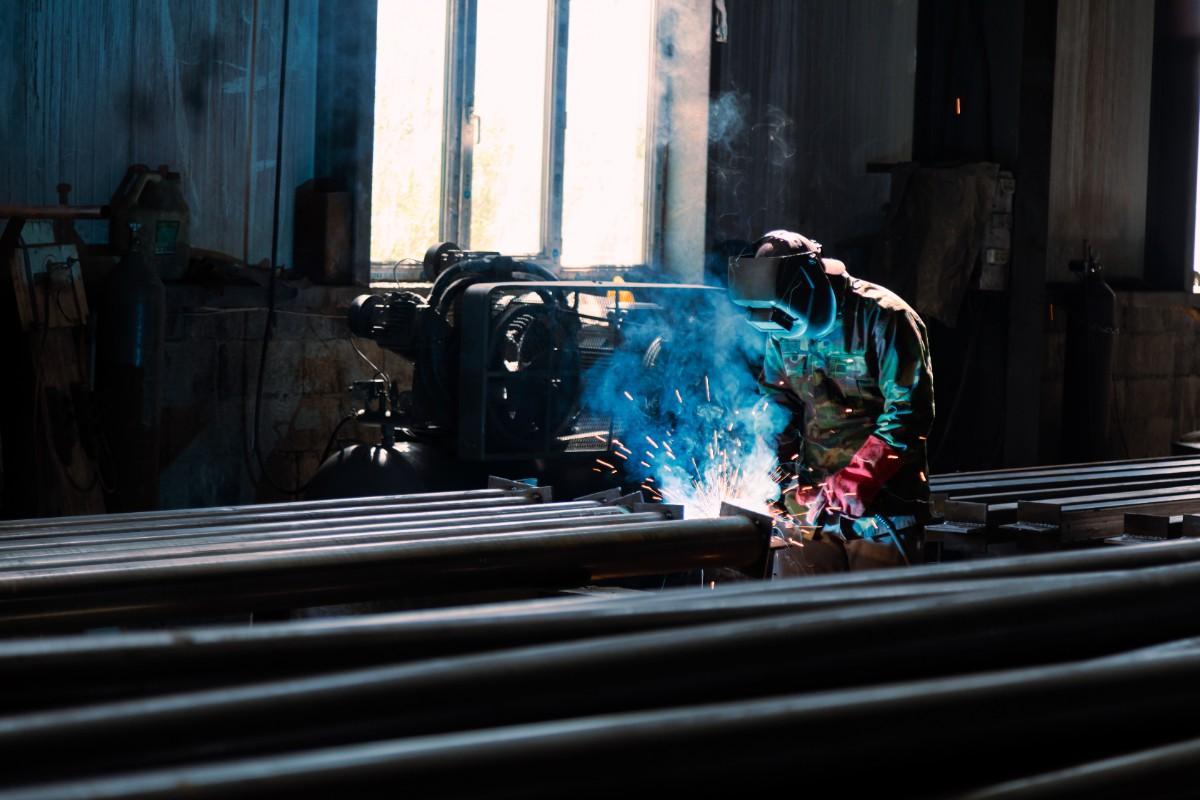
When it comes to industrial piping, the debate around welded vs seamless pipe is one that engineers, procurement teams, and project managers encounter frequently. Although each type of pipe is used in an essential function throughout a majority of industries, the correct type of pipe is not solely based on strength. When determining which type of pipe will be used, other components must also be taken into account such as diameter specifications, price, construction flexibility, and delivery schedules.
This guide breaks down the comparison between welded and seamless pipe in a way that reflects how decisions are actually made on the ground, balancing performance, availability, and cost efficiency.
What is a Welded Pipe?
Through the use of advanced welding methods, a welded pipe is made by rolling steel plates or coils into circles (cylindrical shape), and then joining their edges. Strong and consistent joints are made by using either Electric Resistance Welding (ERW) or manufacturing rolled and welded pipe, depending on the pipe’s intended use. Since welded pipes can be designed for very particular project requirements (dependent on the manufacturing process used), they are not usually available off-the-shelf.
In addition, welded pipes have the advantage of fabrication adaptability. They can be made in alternately large diameters, but they may also be made with an alternately custom-made thick wall to meet individual project requirements. Therefore, they will be especially useful wherever standard pipe sizes do not fulfil the necessary specifications for infrastructure, structural, and large-scale industrial use.
What is a Seamless Steel Pipe?
A seamless steel pipe is produced from a solid steel billet that is heated and pierced to create a hollow tube, without any welding seam. This results in a uniform structure throughout the pipe, offering consistent mechanical properties. Seamless pipes are typically used in applications where high pressure, high temperature, or critical service conditions are involved. Industries such as oil and gas, petrochemicals, and power generation rely on seamless pipes for systems where performance consistency is essential.
However, the manufacturing process also limits the size range and increases production complexity, which can affect both cost and availability.
Welded vs Seamless Pipe: Key Differences
| Parameter | Welded Pipe | Seamless Pipe |
| Manufacturing Process | Made by rolling steel plates or coils and welding the seam longitudinally or spirally | Produced from a solid billet that is heated and pierced to form a hollow tube with no seam |
| Structural Integrity | Contains a weld seam, which may act as a stress concentration point under extreme conditions | No seam, resulting in a uniform structure and consistent strength throughout |
| Strength & Pressure Handling | Suitable for low to medium pressure applications; weld quality plays a key role | Better suited for high-pressure and high-temperature environments due to uniform strength |
| Cost | More economical due to simpler and faster production | Higher cost because of complex manufacturing and material processing |
| Size Availability | Available in a wide range of diameters, especially in large sizes | Limited size range due to manufacturing constraints |
| Surface Finish | Visible weld seam; may require additional finishing depending on application | Smooth and uniform surface with no visible joints |
| Inspection & Testing | Easier to inspect the weld seam using non-destructive testing methods | Requires full-body inspection for material consistency |
| Production Time | Faster production and shorter lead times | Longer production cycles |
| Typical Applications | Construction, water pipelines, structural use, low to medium pressure systems | Oil & gas, petrochemical, power plants, high-pressure systems |
Key Features and Benefits of Welded Pipes
- Large Diameter Capability: In the welded vs seamless pipe comparison, welded pipes can be produced in very large diameters, often exceeding 120 inches, making them ideal for large-scale projects.
- Thick Wall Strength: They support heavy wall thicknesses (up to approx 2 inches), suitable for structural and demanding applications highlighted in the welded pipe vs seamless pipe difference.
- Reliable Weld Quality: Advanced welding methods like DSAW/LSAW with UT and RT testing ensure consistent strength and performance in the seamless vs welded steel pipe comparison.
- Material Versatility: Available in a wide range of grades, allowing flexibility across different industrial requirements within the welded vs seamless pipe selection process.
- Custom Fabrication: Pipes can be manufactured in specific lengths and tolerances, improving installation efficiency and reducing on-site work.
- Cost Efficiency: Welded pipes are more economical and practical, especially for large-diameter applications.
Advantages of Seamless Pipes
- Uniform Structure and Strength: Seamless pipes are manufactured without a weld seam, resulting in consistent material properties throughout the pipe. This is a key factor in the seamless vs welded steel pipe comparison.
- High Pressure and Temperature Resistance: Due to their uniform structure, seamless pipes perform well in high-pressure and high-temperature environments, making them suitable for critical applications.
- No Weld-Related Weak Points: The absence of a weld eliminates concerns related to seam integrity, especially in demanding service conditions often discussed in the welded pipe vs seamless pipe difference.
- Better Performance in Critical Applications: Seamless pipes are commonly used in industries such as oil & gas, petrochemical, and power generation, where reliability under extreme conditions is essential.
- Smooth Surface Finish: These pipes typically have a clean and uniform surface, which can be beneficial in applications requiring minimal friction or consistent flow characteristics.
Applications of Welded Pipes
Welded pipes are widely used in applications where large diameters, structural strength, and customization are required:
- Large-diameter water transmission mains and penstocks
- Outfall and intake pipelines (wastewater, cooling water, desalination)
- Wind tower foundation monopiles and transition pieces
- Tunnel liners and ventilation shafts
- Pile casings for deep foundations and combi-wall systems
- Structural columns in high-rise buildings and bridges
- Pressure vessels and storage tanks (fabricated from rolled sections)
Applications of Seamless Pipes
Seamless pipes are typically used in more specialized and performance-critical environments:
- Oil and gas exploration and production
- Petrochemical processing plants
- Boiler systems and heat exchangers
- High-pressure fluid transport
In the seamless vs welded steel pipe comparison, these applications emphasize where uniform structure and pressure resistance are essential.
Welded vs Seamless Pipe: Which One Should You Choose?
Choosing between welded vs seamless pipe will depend on what your project entails, as many projects may require the benefits of both welded and seamless pipe solutions. For example, a seamless pipe will perform much better in higher-pressure and higher-temperature conditions in which uniformity and consistency of performance are paramount. Conversely, when larger (or smaller) scale applications, custom fabrication requirements, or cost effectiveness are important to your project, a welded pipe can provide many benefits.
At B & W Pipe, we provide both seamless and welded pipe solutions, allowing us to meet the many needs of different industries and applications. Our understanding of the application and how to provide the appropriate piping solution guides us in providing our customers with either the performance of seamless construction or the versatility of welded fabrication. Our fabricated products are unlike traditional mill-manufactured products with respect to custom design, they are custom-engineered to order by our clients. This means that the customer has total control over pipe diameter, total wall thickness, pipe length, and the overall configuration of each piece of pipe they order from us. Our primary focus has been the production of large-diameter, heavy-wall pipes which are traditionally not available from seamless production processes. We work closely with customers across all industries, providing them with engineered piping solutions which meet their specific application requirements.
In the broader seamless vs welded steel pipe discussion, the choice is not about which is better, but which is more suitable for the job.
FAQs
1. What is the main difference between welded vs seamless pipe?
In welded vs seamless pipe, welded pipes are made by joining steel plates or coils, while seamless pipes are formed from a solid billet without a seam.
2. Which is better: welded or seamless pipe?
It depends on the use. In the welded pipe vs seamless pipe difference, welded pipes are better for large, cost-effective projects, while seamless pipes suit high-pressure applications.
3. Are welded pipes strong enough?
Yes, modern welded pipes are strong and reliable. In the seamless vs welded steel pipe comparison, strength depends on the application, not just the type.
4. Why are welded pipes used for large diameters?
Welded pipes can be custom-fabricated in very large sizes, which is not possible with seamless pipes.

Patrick Boatright is the President of B&W Pipe Inc., a leading supplier of carbon steel and API line pipe solutions serving the energy, utility, and infrastructure industries across the United States. A graduate of Southwestern University, Patrick brings decades of experience in the pipe and steel industry and has built a reputation for reliability, product knowledge, and delivering high-quality pipe solutions for projects of all sizes. Under his leadership, B&W Pipe has become known for its extensive inventory, hard-to-find products, and commitment to customer service. Patrick specializes in API 5L line pipe, structural pipe, and custom sourcing solutions tailored to the demands of the oil, gas, waterworks, and industrial sectors.