
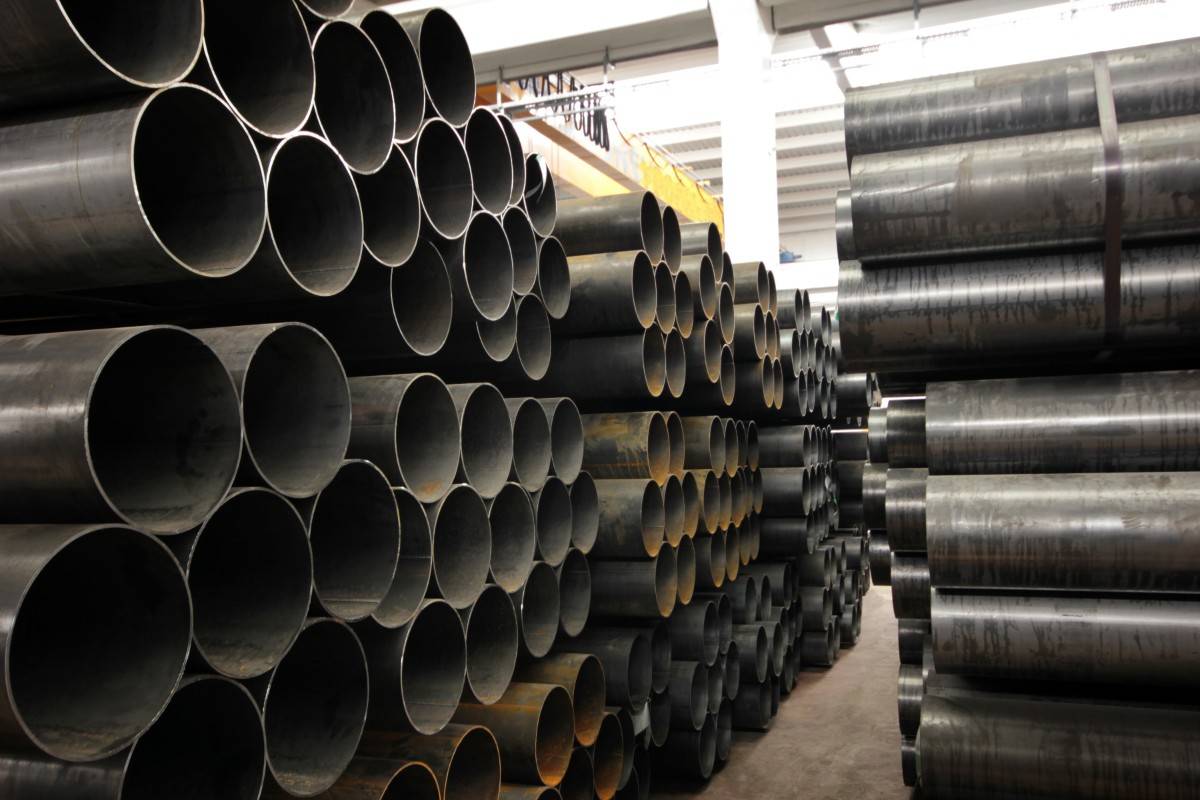
ERW pipes also known as Electric Resistance Welded pipes are widely used across various industries that rely on strong, consistent and cost-effective piping solutions. From infrastructure projects to industrial applications, they have become a practical choice where performance and efficiency matter.
So, what exactly is ERW pipe? The ERW pipe is a type of steel pipe made from rolled sheet steel which is welded along its entire length by applying very high-frequency electrical resistance. As a result, this process produces a consistent weld that provides better quality control and dimensional accuracy. This article explains the types of ERW pipes, their manufacturing process, and their applications.
What Is ERW Pipe
Now that we’ve introduced the term, let’s take a closer look at what ERW pipe actually means. Electric Resistance Welded (ERW) pipe is made by taking flat steel strips or coils and gradually forming them into a round shape. The edges are then joined using high-frequency electrical resistance, which generates enough heat to fuse them together under pressure.
Unlike traditional welding methods, this process doesn’t rely on any filler material. The weld is formed directly from the base metal itself, resulting in a clean and continuous seam along the length of the pipe. In practice, this controlled process helps maintain uniformity in both structure and dimensions, which is one of the reasons ERW pipes are used so widely.
Modern ERW manufacturing often involves High-Frequency Welding (HFW), which works at higher frequencies to produce a more consistent and refined weld. It’s not a completely different category, more of an advancement in how ERW pipes are made today. And in most cases, that added control translates to better overall performance in real-world applications.
At B & W Pipe, we focus on maintaining consistency throughout the ERW manufacturing process. From raw material selection to final inspection, every stage is carefully controlled to ensure reliable weld integrity and precise dimensions. This allows us to deliver ERW pipes that perform consistently across a wide range of industrial and structural applications, without adding unnecessary cost.
Because of this approach, our ERW pipe are well-suited for projects that require both scalability and dependable supply.
Key Features of ERW Pipes
Because of the way they are manufactured, ERW pipes offer several key features that makes them suitable for a wide range of industrial and structural applications.
Fast & Cost-Effective Production
ERW pipes are manufactured rapidly due to their rapid roll, full-forming, and inline welding capabilities. As a result, they can be produced more cost-effectively than seamless pipes or DSAW pipes. This allows for greater efficiency while producing said products.
Excellent Dimensional Accuracy
The controlled manufacturing process ensures tight tolerances in terms of diameter, wall thickness, and overall shape. ERW pipes are typically available from 1/2″ NPS up to 26″ OD, with the most commonly used sizes ranging between 2″ and 24″.
Strong and Clean Weld Seam
The use of high-frequency welding results in a strong, consistent weld that is comparable to the strength of the base metal. The process also minimizes the heat-affected zone, producing a clean weld with little to no internal or external bead.
Wide Range of Grades
ERW pipes are available in a variety of carbon steel grades including API 5L (Gr. B, X42–X80), ASTM A53 (Gr. A/B) and ASTM A500. This versatility makes them suitable for different pressure, structural and industrial requirements.
Smooth Surface Finish
With smooth internal and external surfaces, ERW pipes are well-suited for applications involving fluid flow. The clean finish also makes them easier to coat or treat with processes such as galvanizing, FBE or 3LPE.
Types of ERW Pipes
ERW pipes aren’t all the same. They vary based on how they’re manufactured, the standards they follow and where they’re used. Breaking them down this way makes it easier to choose the right type for a specific application. Check this out!
Based on Welding Process
-
High-Frequency ERW (HFW) Pipes
Most ERW pipes used today fall into this category. They’re made using high-frequency current which helps create a cleaner and more consistent weld. This also improves overall strength and reliability which is why HFW has largely become the standard.
-
Low-Frequency ERW Pipes
This method was used earlier but is now less common. Since it operates at lower frequencies, the weld quality isn’t as refined as what you get with high-frequency welding. For most modern applications it has been replaced by HFW.
Based on Standards and Grades
ERW pipes are manufactured according to different industry standards, depending on where they’re going to be used.
- API 5L is typically used in oil and gas pipelines
- ASTM A53 is common for general mechanical and pressure applications
- ASTM A500 is mostly used in structural work
Each of these standards defines specific requirements, so the pipe performs reliably in its intended environment.
Based on Applications
You’ll also see ERW pipes grouped by how they’re used in the field:
- Line pipes for transporting oil, gas, or water
- Structural pipes used in construction and support systems
- Mechanical tubing found in machinery and industrial equipment
ERW Pipe Manufacturing Process
Now that we have created an understanding of what is ERW pipe, its features and the types of electric resistance welded pipe let’s move on to how they are actually manufactured.
Raw Material Preparation
It all starts with steel coils. These are uncoiled and leveled first to get rid of any surface irregularities. From there, the material is trimmed to the required width, depending on the size of the pipe being produced.
Forming the Steel Strip
The flat strip doesn’t become a pipe in one go. It passes through a series of rollers that gradually bring it into a round shape. This is done without applying heat, which helps preserve the original properties of the steel.
High-Frequency Welding
Once the edges are properly aligned, high-frequency current is introduced. This generates heat right at the edges allowing them to fuse together under pressure. What you get is a continuous weld along the length of the pipe clean and consistent if the process is controlled well.
Weld Bead Removal
After welding, there’s usually a small amount of excess material along the seam. This is removed to smooth out both the inner and outer surfaces. It might seem like a minor step, but it makes a difference, especially in applications where flow or coating is involved.
Sizing and Straightening
At this stage, the pipe is passed through sizing rolls to bring it to the exact dimensions. This helps maintain uniformity across batches and ensures the pipe meets the required tolerances.
Testing and Quality Control
Before the pipes are cleared for use, they go through a series of checks. These typically include non-destructive testing to assess the weld, along with dimensional inspections. The idea is simple, make sure the pipe performs the way it’s expected to once it’s in use.
Applications of ERW Pipes
ERW pipes show up in more places than most people realize. Because they strike a balance between performance and cost, they’re often used in applications where consistency matters, but extreme pressure resistance isn’t the top priority. This widespread use is largely supported by growing demand from industries like construction, energy, and utilities, where large-scale and cost-effective piping solutions are required.
-
Oil and Gas Pipelines
Used in gathering lines, flow lines, and certain transmission pipelines, especially where operating conditions are moderate.
-
Water and Utility Distribution
Widely used in municipal and industrial water systems due to their ability to support steady flow and large-scale deployment.
-
Structural Applications
Commonly used for columns, scaffolding, and fencing, where consistency and ease of fabrication are important.
-
Mechanical and Industrial Use
Found in automotive components, furniture frames, and conveyor systems where uniform shape and finish matter.
-
Fire Protection and HVAC Systems
Suitable for sprinkler systems and HVAC lines that require reliable and cleanly finished piping.
ERW Pipe vs Seamless Pipe
| Feature | ERW Pipes | Seamless Pipes |
| Manufacturing Process | Welded using high-frequency electrical resistance | Made without welding (extruded from solid billet) |
| Cost | More cost-effective | Higher cost due to complex manufacturing |
| Pressure Handling | Suitable for low to medium pressure applications | Ideal for high-pressure and extreme conditions |
| Availability | Easily available in large volumes | Limited availability compared to ERW |
| Dimensional Accuracy | High consistency and tight tolerances | Slight variations possible |
Conclusion
ERW pipes have proven to be the most practical and efficient solution for a wide range of industrial and structural applications. Their ability to deliver consistent quality, precise dimensions, and cost advantages makes them the preferred choice for most projects, especially where scalability and reliability are important. While other pipe types may be used in specialized high-pressure environments, ERW pipes meet the requirements of the majority of real-world applications. This balance of performance and efficiency is what sets them apart.
At B & W Pipe, we build on these advantages by following a controlled and consistent manufacturing process at every stage. From raw material selection to final inspection, our focus remains on weld integrity, dimensional accuracy, and dependable supply. This ensures that the ERW pipes we deliver are not just suitable but reliable for long-term use across industries.
Frequently Asked Questions
1. What is ERW pipe used for?
ERW pipes are used in oil and gas, water systems, construction, and industrial applications.
2. Is ERW pipe better than seamless pipe?
For most industrial uses, ERW pipes offer a more practical and cost-effective solution. Seamless pipes are typically reserved for high-pressure environments.
3. What is HFW in ERW pipes?
HFW is a high-frequency welding process used to improve weld quality and consistency.
4. Are ERW pipes suitable for structural use?
Yes, they are widely used in construction and structural applications.
5. Why are ERW pipes cost-effective?
Their manufacturing process allows for faster production and lower material costs.

Patrick Boatright is the President of B&W Pipe Inc., a leading supplier of carbon steel and API line pipe solutions serving the energy, utility, and infrastructure industries across the United States. A graduate of Southwestern University, Patrick brings decades of experience in the pipe and steel industry and has built a reputation for reliability, product knowledge, and delivering high-quality pipe solutions for projects of all sizes. Under his leadership, B&W Pipe has become known for its extensive inventory, hard-to-find products, and commitment to customer service. Patrick specializes in API 5L line pipe, structural pipe, and custom sourcing solutions tailored to the demands of the oil, gas, waterworks, and industrial sectors.