
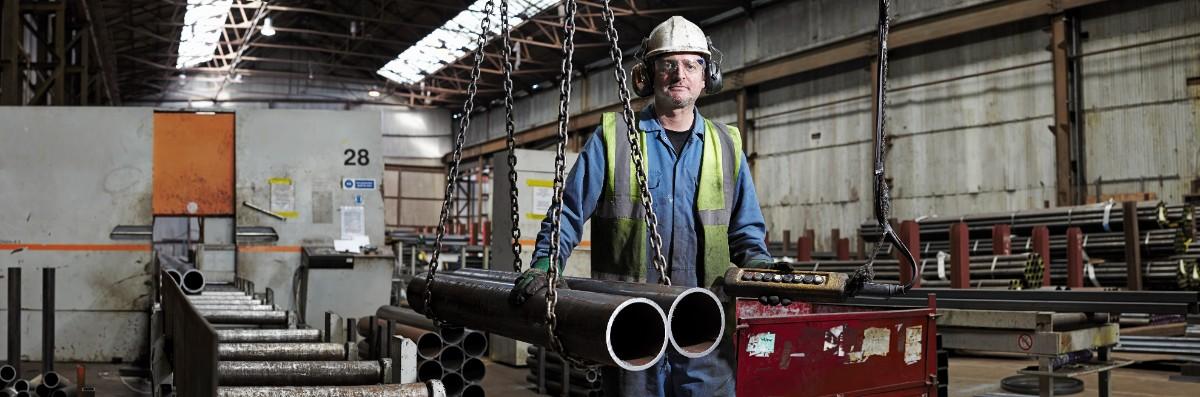
Summary: So what does DSAW mean? DSAW stands for Double Submerged Arc Welded, a pipe manufacturing process where two weld passes are made, one on the inside of the pipe and one on the outside, using a submerged arc welding technique that keeps the arc buried under a layer of flux during welding. The result is a pipe with a strong, consistent weld seam that performs reliably in large-diameter, high-pressure, and structurally demanding applications. DSAW pipe is a core part of B&W Pipe’s product line and one of the most specified pipe types in oil and gas gathering, transmission, piling, and offshore work. This guide walks through what the process involves, how it compares to other pipe types, and when DSAW is the right call for your project.
If you’ve been sourcing steel pipe long enough, you’ve come across the term DSAW on a mill certification, a purchase order, or a distributor’s stock list, and if nobody explained it clearly the first time, you may have just moved on. This guide fixes that.
Understanding what DSAW means isn’t just a terminology exercise. It changes how you spec pipe, which applications it fits, and why it gets chosen over other pipe types when the job demands it.
What Does DSAW Mean? The Full Breakdown
DSAW stands for Double Submerged Arc Welded. Each word in that name tells you something specific about how the pipe is made:
Double – Two weld passes are made. One from inside the pipe, one from outside. This is what separates DSAW from standard SAW (Submerged Arc Welded) pipe, which uses only a single pass. The double pass ensures full penetration through the pipe wall and eliminates the risk of incomplete fusion that can occur with a single weld run on heavier wall material.
Submerged – The welding arc is submerged beneath a layer of granular flux during the weld. This shields the weld pool from atmospheric contamination, oxygen, nitrogen, and hydrogen, which would otherwise introduce porosity and weaken the weld. The flux also stabilizes the arc and produces a cleaner, more uniform weld bead than open-arc processes.
Arc Welded – The heat comes from an electric arc, not a flame, not friction. That matters because arc welding drives heat deep into the material. On a heavy-wall pipe, you need that penetration to get a proper fusion all the way through. A surface-level weld on thick steel isn’t a weld worth having.
Put it together, and what does DSAW mean in practical terms? It means a pipe manufactured with two full weld passes under controlled flux-shielded conditions, producing a seam weld that meets demanding mechanical and pressure requirements across a wide range of applications.
How DSAW Pipe Is Made
The manufacturing process starts with a steel plate, not a coiled strip like ERW pipe. The plate is cut to width, formed into a cylinder using a series of forming rolls or a press brake process, and then welded along the longitudinal seam. The weld sequence is what defines DSAW:
- Step 1: Tack welding. The formed cylinder is held in shape with intermittent tack welds before the main weld passes begin. This keeps the seam aligned and prevents distortion during the high-heat welding process.
- Step 2: Inside weld pass. The first full weld pass runs along the inside of the pipe seam using a submerged arc process. Flux is deposited ahead of the arc, the arc runs beneath it, and the slag is removed after the pass is complete.
- Step 3: Outside weld pass. The second full pass runs along the outside of the seam, again using the submerged arc process. This pass ties into the inside weld, ensuring complete fusion through the full wall thickness.
- Step 4: Inspection and testing. DSAW pipe is subject to hydrostatic testing, ultrasonic inspection of the weld seam, and dimensional verification before it leaves the mill. For line pipe applications, API 5L requires additional non-destructive examination of the weld and pipe body.
The result is a pipe where the weld seam is as strong as and in many cases stronger than the surrounding base material.
DSAW vs. ERW vs. SMLS: What’s the Difference?
Understanding what does DSAW means is easier when you see it alongside the other pipe manufacturing methods B&W Pipe carries:
DSAW vs. ERW (Electric Resistance Welded)
ERW pipe is made from a coiled steel strip that is formed and welded using electrical resistance heat, with no filler material or flux. ERW is faster and more economical to produce, and it works well for smaller diameters and standard wall thicknesses. But ERW has practical upper limits on diameter and wall thickness. When pipe size moves into the larger OD range, typically above 16 inches, and wall thickness increases, DSAW becomes the more reliable manufacturing method. The double-weld pass gives DSAW a structural advantage on heavy-wall, large-diameter applications that ERW can’t match.
DSAW vs. SMLS (Seamless)
A seamless pipe has no weld seam at all; it’s formed by piercing and extruding a solid steel billet. That absence of a seam is an advantage in high-pressure, high-temperature, and cyclic loading applications where a weld zone could be a performance variable. However, seamless pipe has practical limits on diameter, as it becomes increasingly difficult and expensive to produce in large OD sizes. DSAW fills the gap with a large diameter pipe that can be produced to tight dimensional tolerances with a weld seam that meets stringent mechanical requirements. For large-diameter line pipe, DSAW is often the only practical option.
The practical summary:
- Small to mid diameter, standard wall → ERW
- High pressure, high temperature, smaller diameter → SMLS
- Large diameter, heavier wall, structural and line pipe → DSAW
Where DSAW Pipe Gets Specified
Knowing what does DSAW means is one thing, knowing where it performs best is what makes the specification decision straightforward.
Oil and gas transmission lines
Large-diameter DSAW pipe is the backbone of long-distance pipeline infrastructure. The combination of large OD, controlled wall thickness, and a weld seam qualified to API 5L makes it the standard choice for high-pressure hydrocarbon transmission. Grades from API 5L X52 through X70 are common in these applications.
Gas gathering systems
Gathering lines operating at elevated pressures in oilfield environments frequently specify DSAW pipe in higher API grades. The ability to produce DSAW in a range of wall thicknesses and have those walls verified through ultrasonic inspection gives operators confidence in weld integrity across long buried runs.
Structural and piling applications
DSAW pipe’s large diameter capability makes it well suited for foundation piling, offshore platform legs, and structural columns where load-bearing capacity matters more than pressure rating. The consistent OD and weld quality make it easier to work with in fabrication environments.
Offshore applications
Subsea and offshore piping systems demand pipe that performs reliably under external pressure, cyclic loading, and corrosive environments. DSAW pipe in appropriate grades and wall thicknesses, combined with external coating systems like FBE and ARO, is a proven combination for offshore service.
Directional drilling and trenchless installation
Large-diameter DSAW pipe is used in horizontal directional drilling (HDD) crossings where the pipe is pulled through a bore rather than laid in a trench. The weld seam integrity and dimensional consistency of DSAW pipe are critical in these applications; any seam defect or OD variation creates problems during pullback.
What to Confirm When Ordering DSAW Pipe
Once you understand what does DSAW means and have confirmed it’s the right pipe type for your application, these are the specification points to have ready before placing an order:
- OD and wall thickness: DSAW is produced in a wide range of sizes. Confirm actual OD and required wall thickness, not just nominal size and schedule.
- Grade: API 5L GR B through X70 covers most line pipe and gathering applications. Structural and piling work may reference ASTM A252 or project-specific requirements.
- Length: DSAW pipe is typically available in double random lengths. Confirm the required length range for your project logistics and welding schedule.
- Inspection requirements: API 5L DSAW pipe requires ultrasonic inspection of the weld seam. Additional NDE, hydrostatic testing frequency, and third-party inspection requirements should be confirmed against your project specification before ordering.
- Coating requirements: if the pipe requires FBE, ARO, or internal lining, confirm coating specification, holiday testing requirements, and cutback dimensions at the weld ends.
Need DSAW Pipe for Your Next Project?
Now that you know what does DSAW means and where it performs, the next step is confirming availability for your specific size, grade, and coating requirements. B&W Pipe has been supplying DSAW pipe to oil and gas, structural, and offshore customers across Texas and beyond since 2001. We carry DSAW alongside ERW, SMLS, and rolled and welded pipe with the inventory depth and specialty sourcing capability to handle both standard and hard-to-find specifications.
Call us at (281) 391-6688, email – sales@bwpipe.biz, or visit bwpipeinc.com to check availability, download our current stock list, or get a quote. Tell us your OD, wall, grade, and coating requirements, and we’ll take it from there.
Frequently Asked Questions
Q1. What does DSAW mean in simple terms?
DSAW stands for Double Submerged Arc Welded. It means the pipe is made from a steel plate that is formed into a cylinder and welded along the seam with two passes, one inside, one outside, using a flux-shielded arc welding process.
Q2. What does DSAW mean compared to ERW, and which is better?
Neither is universally better; they serve different applications. ERW is more economical for smaller diameters and standard walls. DSAW handles larger diameters and heavier walls where ERW isn’t practical. The right choice depends on your OD, wall thickness, and application requirements.
Q3. Is DSAW pipe suitable for high-pressure applications?
Yes, when produced to API 5L in appropriate grades and wall thicknesses. The double-weld pass and ultrasonic seam inspection give DSAW pipe the weld integrity needed for pressure-rated line pipe service.
Q4. What sizes does DSAW pipe typically come in?
DSAW is most commonly produced in larger diameter ranges, typically 16 inches OD and above, though some mills produce it in smaller sizes. Wall thickness ranges vary by producer and grade. Contact B&W Pipe for the current size and availability on specific project requirements.
Q5. Does B&W Pipe supply DSAW with coating?
Yes. B&W Pipe supplies DSAW pipe with FBE coating, Abrasion Resistant Overcoat (ARO), and cement mortar lining depending on application requirements. Third-party inspection coordination is also available.

Patrick Boatright is the President of B&W Pipe Inc., a leading supplier of carbon steel and API line pipe solutions serving the energy, utility, and infrastructure industries across the United States. A graduate of Southwestern University, Patrick brings decades of experience in the pipe and steel industry and has built a reputation for reliability, product knowledge, and delivering high-quality pipe solutions for projects of all sizes. Under his leadership, B&W Pipe has become known for its extensive inventory, hard-to-find products, and commitment to customer service. Patrick specializes in API 5L line pipe, structural pipe, and custom sourcing solutions tailored to the demands of the oil, gas, waterworks, and industrial sectors.