
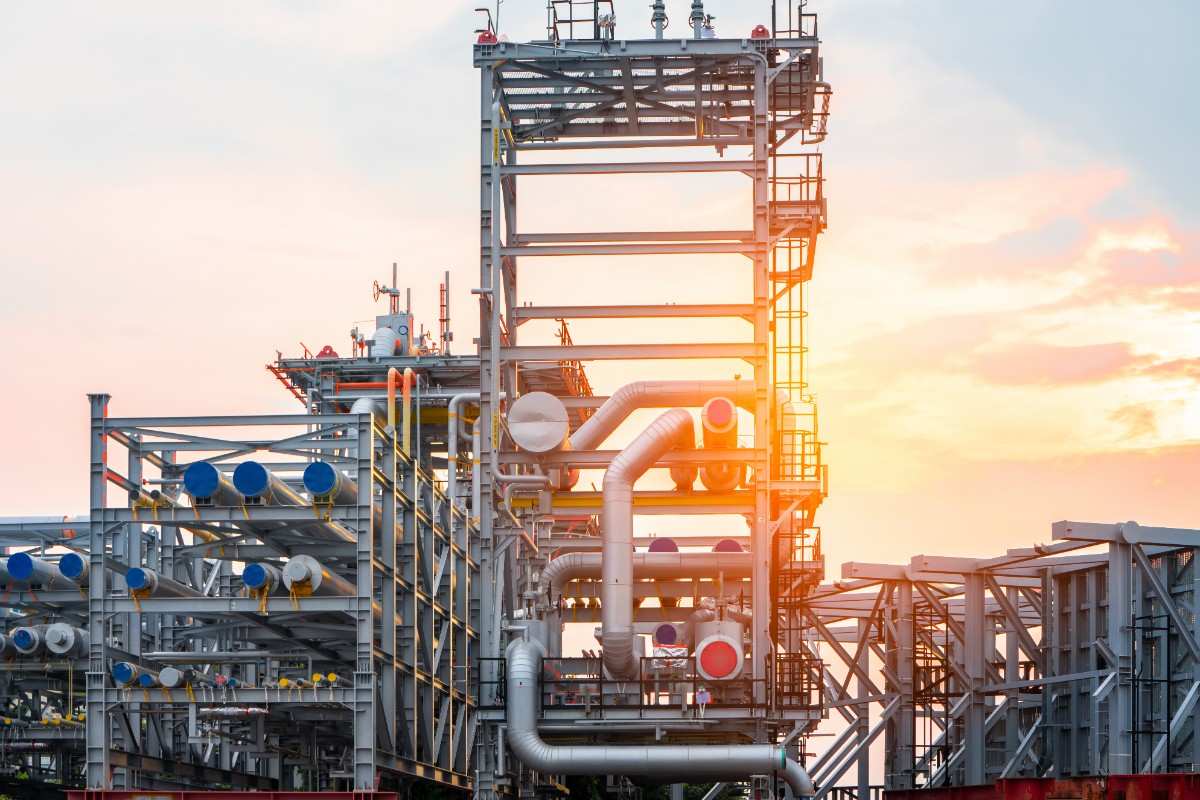
Summary: Steel pipe is the infrastructure that moves oil and gas from wellhead to refinery to end user, and its role shifts at each stage of the value chain, gathering lines and wellhead piping upstream, transmission pipelines and compressor station piping midstream, and refinery process piping downstream. The pipe type, grade, and coating all change based on that role, which is why steel pipe for oil and gas industry applications spans multiple product lines rather than a single standard spec.
Steel pipe is the physical infrastructure that moves oil and gas from wellhead to refinery to end user. It’s what makes the entire supply chain physically possible, and its role shifts at every stage. Gathering lines pull raw product from the well. Transmission pipelines move it across regions. Process piping handles it inside the refinery. Steel pipe for oil and gas industry applications isn’t one product doing one job; it’s a family of specifications, each matched to the pressure, distance, and service conditions of its stage in the value chain.
This guide walks through where steel pipe shows up across upstream, midstream, and downstream operations, and why the pipe type, grade, and coating change as the role changes.
Why the Oil and Gas Industry Relies on Steel Pipe
A handful of properties make steel the default material for steel pipe for oil and gas industry service, rather than an occasional substitute:
-
Pressure containment
Steel’s yield and tensile strength let it hold internal pressure reliably across a wide range of diameters and wall thicknesses, which is the core requirement for anything carrying gas or liquid hydrocarbons.
-
Corrosion resistance (with coating)
On its own, carbon steel corrodes like any ferrous metal. Paired with the right external coating and internal lining, it holds up for decades in buried and exposed service.
-
Weldability
Steel accepts field welding and fabrication cleanly, which matters when a pipeline crosses hundreds of miles and needs consistent joints along the way.
-
Code compliance
Steel pipe manufactured to API 5L and governed by ASME B31.4 (liquid pipelines) and B31.8 (gas pipelines) gives operators a documented, code-recognized basis for design and inspection something alternative materials can’t match at the pressures and diameters this industry runs.
Together, these are why steel pipe for oil and gas industry remains the standard rather than plastic, fiberglass, or composite alternatives once pressure, distance, and code compliance enter the picture.
The Role of Steel Pipe in Upstream Operations
Upstream is where the raw product first meets pipe. Gathering lines and wellhead piping move oil and gas from the well to initial processing or storage, often across rougher terrain and in smaller diameters than what shows up further down the chain. At this stage, the priority is getting product to a gathering point or processing facility reliably, without over-specifying pipe for pressures the gathering system doesn’t demand.
The Role of Steel Pipe in Midstream Operations
Midstream is where distance becomes the defining factor. Transmission pipelines and compressor station piping move product over long distances between regions and facilities, which means larger diameters, higher operating pressures, and pipe designed to hold up over hundreds of miles of buried service. This is also where B31.8’s design factors for populated areas come into play, since transmission lines often cross varied terrain and proximity classes along a single route.
The Role of Steel Pipe in Downstream Operations
Downstream brings the product into refinery process piping and storage terminal piping, where conditions get more complex. Temperature, chemical exposure, and process-specific pressure requirements replace the straightforward transport role pipe played upstream and midstream. This is typically where seamless pipe and higher-grade specifications become more common, since process conditions inside a refinery are less forgiving than a straight transmission run.
Pipe Types Matched to Each Role
Not every role calls for the same steel pipe for oil and gas industry type:
- ERW/HFW: well suited to gathering and distribution service, where diameter and pressure requirements sit in a moderate range
- DSAW: the standard for large-diameter transmission, including offshore structures and piling, where distributors stock sizes from 6⅝” OD up to 60″ OD
- SMLS (Seamless): reserved for higher-pressure, higher-stress service, including process piping and elevated-temperature applications where a weld seam would become the limiting factor
- Rolled & Welded: built for large-diameter, custom-spec runs where standard mill sizes don’t fit the project’s dimensional requirements
Matching pipe type to role isn’t a formality; it’s the difference between a gathering system built cost-effectively and a transmission line rated correctly for the pressure it needs to hold.
Why Grade and Coating Matter for Pipeline Integrity
Pipe type is only part of the specification. API 5L grades span from Grade B through X70, and the grade selected affects allowable pressure independent of wall thickness, the same logic covered in more depth in our Carbon Steel Pipe Schedule Chart Explained guide.
Coating and lining matter just as much as grade. O.D. coatings, field joint material, and I.D. cement mortar lining to AWWA specifications all protect the pipe against the specific corrosion risks of its service environment buried, submerged, or exposed. Our pipe coating guide covers the coating types in more detail. The role a section of steel pipe for oil and gas industry service plays doesn’t just determine its size and type, it determines the grade and coating system that keep it performing for the life of the project.
Supporting Services That Keep Oil and Gas Pipe Projects Moving
Pipe supply is rarely the only piece of a pipeline project. B&W Pipe supports the surrounding workflow with:
- ROW stringing: getting pipe positioned along the right-of-way ahead of installation
- Third-party inspection: independent verification of material and weld quality
- Machined valve pups: fabricated to spec in virtually any grade, wall, or diameter
- Pipeline transitions: fabricated connections between differing pipe specifications along a single route
Why Choose B&W Pipe for Oil and Gas Steel Pipe Supply
B&W Pipe has specialized in API 5L line pipe for hydrocarbon gathering and distribution since 2001, with a deliberate focus on niche and hard-to-find sizes and grades that standard distributors often can’t source. Every order ships with Mill Test Report certification, and inventory across three Texas locations, including Katy, Houston (Patriot Pipe Services), and New Braunfels, supports faster regional fulfillment than a single-yard supplier. An in-house machine shop adds valve pup fabrication to the mix, so pipe and connecting components can come from a single source instead of multiple vendors.
Frequently Asked Questions
Q.1 What is steel pipe for oil and gas industry used for?
Steel pipe moves oil and gas at every stage, gathering raw product from wells, transmitting it across regions, and handling it inside refinery and storage terminal processes. It’s the physical infrastructure connecting each part of the supply chain.
Q.2 What’s the difference between gathering, transmission, and process pipe?
Gathering pipe moves raw product from wells to initial processing, usually at smaller diameters and lower pressure. Transmission pipe moves product over long distances at larger diameters and higher pressure. Process pipe handles refined product and complex conditions inside a facility, often requiring seamless construction and tighter tolerances.
Q.3 Why is steel the standard material for oil and gas pipelines?
Steel pipe for oil and gas industry combines pressure containment, weldability, and code compliance under API 5L and ASME B31.4/B31.8 in a way that alternative materials can’t match at the pressures and diameters this industry operates at.
Q.4 What pipe grade is used for oil and gas pipelines?
Grades range from API 5L Grade B through X70, with the specific grade selected based on the pressure, diameter, and service conditions of that section of the pipeline. Higher grades allow more pressure capacity without increasing wall thickness.

Patrick Boatright is the President of B&W Pipe Inc., a leading supplier of carbon steel and API line pipe solutions serving the energy, utility, and infrastructure industries across the United States. A graduate of Southwestern University, Patrick brings decades of experience in the pipe and steel industry and has built a reputation for reliability, product knowledge, and delivering high-quality pipe solutions for projects of all sizes. Under his leadership, B&W Pipe has become known for its extensive inventory, hard-to-find products, and commitment to customer service. Patrick specializes in API 5L line pipe, structural pipe, and custom sourcing solutions tailored to the demands of the oil, gas, waterworks, and industrial sectors.