
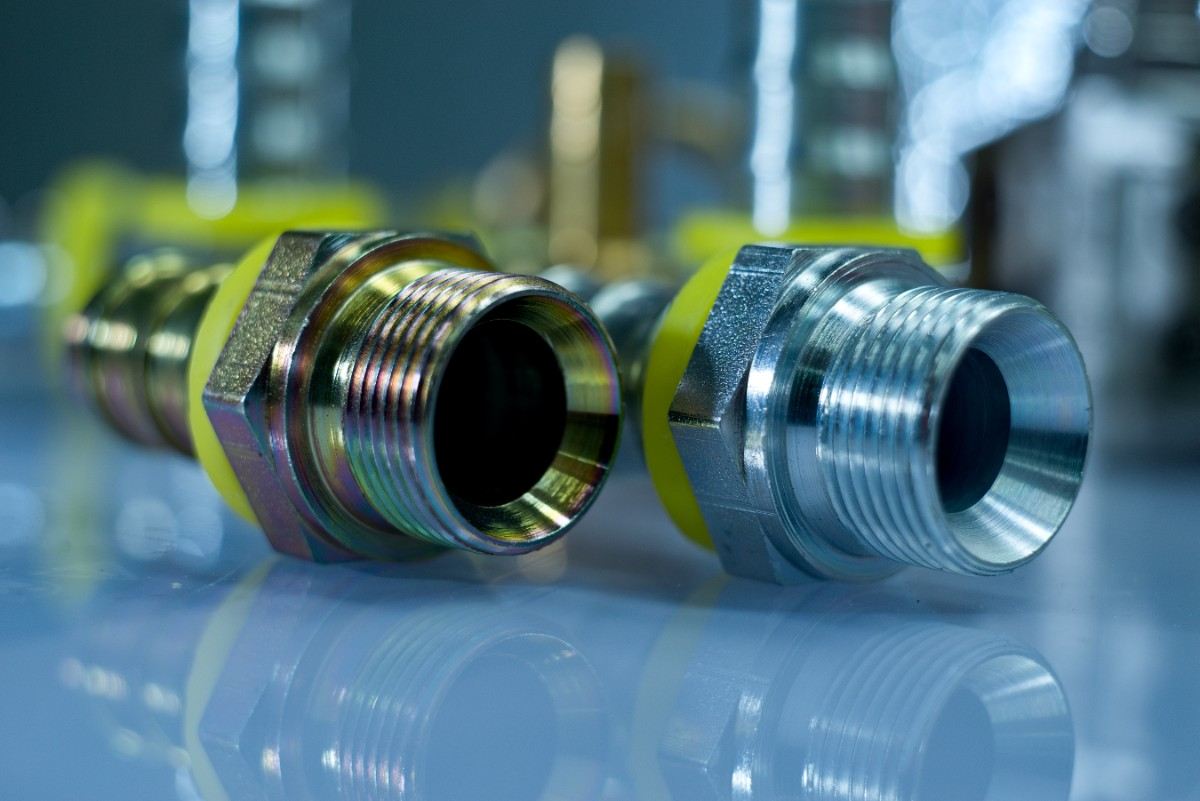
Summary: FIP vs NPT is not a choice between two thread types. NPT is the thread standard, and FIP (Female Iron Pipe) is plumbing-trade shorthand for an internal NPT thread. A fitting labeled FIP will accept an NPT male thread, which is why the two terms get mixed up on spec sheets and in catalogs.
Search a plumbing supply catalog, and you will find FIP and MIP. Search an industrial catalog, and you will find FNPT and MNPT. Both describe the same family of tapered pipe threads, and that overlap is where ordering mistakes start. A buyer who sees “FIP” on one sheet and “NPT” on another often assumes two different threads and either orders the wrong part or wastes time chasing a difference that does not exist.
This guide explains what FIP means, how FIP vs NPT actually relate, how to read the abbreviations, and what connects to what. B&W Pipe supplies NPT-threaded carbon steel fittings, so it also covers how this fits into an industrial threaded system.
What Does FIP Mean?
FIP stands for Female Iron Pipe. It is an internal (female) tapered thread cut inside the bore of a fitting, coupling, or valve port. It receives a male thread the way a socket receives a plug.
The “iron pipe” part is a leftover from older naming. Pipe sizes were once tied to iron pipe size conventions, and the plumbing trade kept the label long after steel and other materials took over. The thread itself is not unique to iron.
If the male and female basics are new to you, our MNPT vs FNPT guide covers them in detail.
What Is NPT?
NPT stands for National Pipe Taper. It is the standard tapered pipe thread in North America, defined by ASME B1.20.1. The thread narrows along its length, so as the male thread turns into the female thread, the flanks wedge together and form most of the seal. Thread sealant tape or pipe dope fills what remains.
For the full explanation of how the taper works, see What Is an NPT Thread?
FIP vs NPT: What’s the Difference?
The short answer is that they describe different things. NPT names the thread standard. FIP names the gender of a thread that follows that standard.
| Term | What It Describes | Thread Standard | Where You’ll See It |
|---|---|---|---|
| NPT | The thread type (tapered) | ASME B1.20.1 | Industrial and general piping |
| FIP | A female, internal thread | NPT (tapered) | Plumbing supply and fixtures |
A fair way to put it: every FIP thread is an NPT thread, but not every NPT thread is FIP. An external NPT thread is male. Only the internal version carries the FIP label. So when comparing FIP vs NPT, you are comparing a gender label to a standard, not two competing threads.
FIP, MIP, FPT, and FNPT: Reading the Abbreviations
Different catalogs use different shorthand for the same thread. The first letter is the gender, and the rest names the thread family.
| Abbreviation | Meaning | Gender | Common Context |
|---|---|---|---|
| FIP | Female Iron Pipe | Female | Plumbing supply |
| MIP | Male Iron Pipe | Male | Plumbing supply |
| FPT | Female Pipe Thread | Female | General and industrial |
| MPT | Male Pipe Thread | Male | General and industrial |
| FNPT | Female National Pipe Taper | Female | Industrial |
| MNPT | Male National Pipe Taper | Male | Industrial |
Read it in two parts. The F or M tells you which half of the connection you are holding. The IP, PT, or NPT tells you the thread family, and here all three point to the same tapered pipe thread.
Is FIP the Same as NPT?
Functionally, yes. A FIP thread is an internal NPT thread, and it will mate with the matching male NPT thread of the same nominal size. That is why the question FIP vs NPT keeps coming up: the two terms are used interchangeably by people in different trades.
The shorthand persists because plumbing suppliers and industrial suppliers developed their catalog language separately. Neither is wrong. They simply label the same thread from different directions.
When ordering, confirm three things instead of relying on the name: the gender, the nominal size, and the thread type. If all three match, the label on the box does not matter.
How FIP Connects to Other Thread Types
Compatibility depends on thread family, not on the label.
| Connection | Compatible | How to Seal |
|---|---|---|
| FIP to MIP | Yes | Thread sealant tape or pipe dope |
| FIP to MNPT | Yes | Thread sealant tape or pipe dope |
| FIP to NPTF (Dryseal) | Yes, as an NPT joint | Thread sealant tape or pipe dope |
| FIP to straight pipe thread (NPS) | Not reliably | Needs a gasket or O-ring |
| FIP to garden hose thread | No | Different thread form |
The garden hose connection trips up a lot of buyers. Hose threads are straight and have a different pitch, so a 3/4″ hose thread does not mate with a 3/4″ FIP fitting, even though both are called 3/4″. The nominal size matches, but the threads do not.
Where FIP vs NPT Are Used
FIP is the plumbing trade’s word, so it shows up on:
- Water heater connections
- Faucet and fixture supply ports
- Residential and light commercial water lines
- Valves and fittings sold through plumbing supply
NPT is the broader industrial term, so it shows up on:
- Instrument connections and sample lines
- Small-bore utility piping
- Valve and gauge ports
- Low-to-moderate pressure industrial systems
The threads are the same. The trade you buy from sets the vocabulary.
Common Mistakes When Ordering FIP or NPT Fittings
- Treating FIP vs NPT as different standards. They describe the same thread family, so searching for a difference wastes time.
- Ordering the wrong gender. Two male ends or two female ends will not connect without an adapter or coupling.
- Assuming a hose thread mates with FIP. Straight hose threads and tapered pipe threads are not interchangeable.
- Skipping sealant. A tapered joint still needs tape or pipe dope to close the remaining gap.
How B&W Pipe Supports Threaded Fitting Needs
B&W Pipe supplies NPT-threaded carbon steel fittings, including elbows, tees, couplings, bushings, and plugs, for lower-pressure systems that need straightforward assembly. They are manufactured to ASTM A105 and available in a full range of sizes.
For higher-pressure small-bore work, B&W also supplies forged socket weld fittings in Class 3000, 6000, and 9000 ratings, commonly used for instrument lines, chemical injection points, and utility connections in refineries and processing plants.
Every order ships with full mill certifications and material traceability. For the complete range, see our Industrial Pipe Fittings page.
Frequently Asked Questions
Q.1 What does FIP stand for?
FIP stands for Female Iron Pipe. It is an internal tapered pipe thread cut inside a fitting that receives a male thread.
Q.2 Is FIP the same as NPT?
A FIP thread is an NPT thread. FIP is plumbing-trade shorthand for the female, internal version of the NPT standard, so the two will mate with the matching male thread.
Q.3 What is the difference between FIP and FPT?
Nothing meaningful. FIP is the older plumbing term, and FPT is the more general term, and both describe a female tapered pipe thread.
Q.4 Is FIP male or female?
Female. The F stands for female, and the thread is cut inside the fitting’s bore.
Q.5 Can you connect FIP to MIP?
Yes. FIP is the female side, and MIP is the male side of the same tapered thread family. Seal the joint with thread sealant tape or pipe dope.
Q.6 What thread type do B&W’s threaded fittings use?
B&W Pipe’s threaded carbon steel fittings are NPT-threaded and made to ASTM A105.

Patrick Boatright is the President of B&W Pipe Inc., a leading supplier of carbon steel and API line pipe solutions serving the energy, utility, and infrastructure industries across the United States. A graduate of Southwestern University, Patrick brings decades of experience in the pipe and steel industry and has built a reputation for reliability, product knowledge, and delivering high-quality pipe solutions for projects of all sizes. Under his leadership, B&W Pipe has become known for its extensive inventory, hard-to-find products, and commitment to customer service. Patrick specializes in API 5L line pipe, structural pipe, and custom sourcing solutions tailored to the demands of the oil, gas, waterworks, and industrial sectors.