
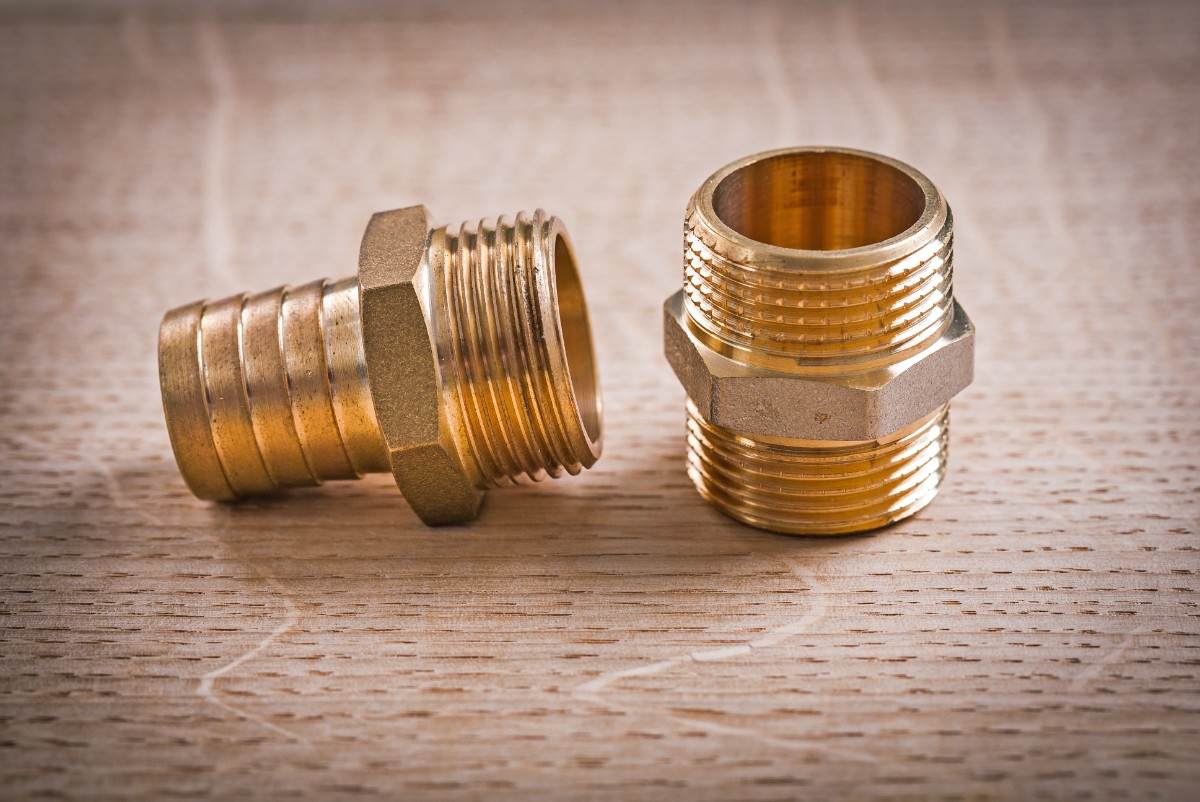
Summary: NPT vs BSP is a comparison of two thread systems that look alike but aren’t interchangeable. NPT has a 60° thread angle and is the standard in North America. BSP uses a 55° Whitworth angle and is the standard across most of the rest of the world. Even where the pitch matches, the angle doesn’t, so the threads won’t seal together.
A valve arrives from overseas. The fitting threads in smoothly for a turn or two, then stops. The installer tightens it down, wraps it in more tape, and it still weeps. Nothing is defective. The valve has a BSP thread, and the pipe has an NPT thread, and the two were never designed to mate.
This guide explains how the two systems differ, why mixing them fails, how to tell them apart, and what to do when you have a mismatch. It focuses on the NPT vs BSP question that comes up whenever imported equipment meets North American piping.
What Is NPT?
NPT stands for National Pipe Taper. It is the standard tapered pipe thread in the United States and Canada, defined by ASME B1.20.1. The thread has a 60° angle, flat crests and roots, and a taper of 3/4 inch per foot. As a male thread turns into a female thread, the flanks wedge together and form most of the seal, and thread sealant tape or pipe dope fills the remaining gap.
For the full explanation, see our guide to What Is an NPT Thread?
What Is BSP?
BSP stands for British Standard Pipe. It is the Whitworth-based thread system used across the UK, Europe, Asia, Australia, and many other regions. Its thread angle is 55°, and its crests and roots are rounded instead of flat. BSP comes in two types:
| Type | Also Marked | Form | Standard | How It Seals |
|---|---|---|---|---|
| BSPT (tapered) | R (male), Rc (female) | Tapered | ISO 7-1 | Taper plus sealant |
| BSPP (parallel) | G | Straight | ISO 228-1 | Bonded washer or O-ring |
BSPT seals the way NPT does, through the taper. BSPP does not seal on the thread at all. It relies on a washer or O-ring pressed against a face, which makes it a different connection even though the thread looks similar.
NPT vs BSP: Key Differences
| Factor | NPT | BSP |
|---|---|---|
| Origin | United States | United Kingdom (Whitworth) |
| Thread angle | 60° | 55° |
| Crest and root shape | Flat | Rounded |
| Taper | Tapered | Tapered (BSPT) or parallel (BSPP) |
| Sealing method | Taper plus tape or dope | Taper plus sealant (BSPT), washer or O-ring (BSPP) |
| Where used | North America | Most of the world outside North America |
| Governing standard | ASME B1.20.1 | ISO 7-1 and ISO 228-1 |
The short answer for NPT thread vs BSP: the angle, the crest shape, and the sealing method all differ, so the two systems are not interchangeable.
Threads Per Inch: Common Sizes Compared
Threads per inch (TPI) is where the confusion starts, because the two systems match at some sizes and miss at others. At 1/8″ NPT runs 27 threads per inch against 28 for BSP, and at 1/4″ and 3/8″ it runs 18 against 19. The pitch lines up exactly at 1/2″ and 3/4″, where both systems use 14 threads per inch, so the threads start easily and feel like they fit. From 1″ through 2″, NPT uses 11.5 threads per inch and BSP uses 11. At every size where the pitch differs, the gap is only a fraction of a thread per inch, which shows up as binding after a few turns. In both cases “close” is misleading, because pitch is only one of the things that has to match. The thread angle, 60° for NPT and 55° for BSP, never lines up at any size.
Are NPT and BSP Compatible?
No. Even at sizes where the TPI matches, the 60° NPT thread and the 55° BSP thread do not seat against each other. The flanks touch at the wrong angles, so only a small part of each thread carries the load and the rest leaves gaps.
Forcing the two together causes predictable damage:
- Partial engagement. Only a few threads make contact, so the joint is weak.
- Leaks. The gaps between mismatched flanks form a spiral leak path.
- Galled and cracked threads. Overtightening to stop the leak tears threads and can split a female port.
Sealant tape will not fix it. Tape fills small gaps, but it cannot make two different thread forms mate. At best, it hides the leak for a short time.
BSPT vs NPT: The Closest Look-Alikes
The comparison people get wrong most often is bspt thread vs npt. Both are tapered, both seal on the taper, and both use sealant, so they look like the same thing under different names.
The differences are still enough to prevent a good seal. BSPT has a 55° angle and rounded crests, while NPT has a 60° angle and flat crests. The pitch also differs at many sizes. A BSPT male thread may start into an NPT female port, but the flanks will not draw up evenly, and the joint will not hold pressure reliably.
How to Tell NPT from BSP
When you cannot tell by looking, use these checks:
- Read the markings and catalog codes. NPT parts are marked NPT. BSP parts show R, Rc, Rp, or G, sometimes with “BSP” or “BSPT.”
- Measure the pitch. A thread pitch gauge shows the TPI quickly.
- Check the thread angle. A thread form gauge or optical comparator separates 60° from 55°.
- Look at the drawing and origin. Equipment from Europe, the UK, or Asia is far more likely to be BSP.
- Confirm with the supplier. If anything is unclear, ask before installing.
Thread callouts also differ. A North American drawing says something like “1/2-14 NPT.” A BSP drawing says “R 1/2” for a tapered male thread or “G 1/2” for a parallel thread.
How to Connect NPT and BSP Systems
You have three reliable options:
- Use a purpose-made adapter. Adapter fittings with NPT on one end and BSP on the other are made for exactly this case. Match the gender, size, and BSP type (tapered or parallel) on the BSP end.
- Replace the mismatched part. If the equipment is replaceable, ordering it with the correct thread is often the simplest fix.
- Use a welded or flanged transition. For permanent connections, a weld or flange avoids the thread mismatch entirely.
What not to do: force the threads together, add layers of tape, or assume a hand-tight start means a good fit.
Where NPT and BSP Are Used
| Region | Typical Standard | Common Applications |
|---|---|---|
| United States and Canada | NPT | Plumbing, industrial piping, instrument connections |
| UK and Europe | BSPT and BSPP | Plumbing, hydraulics, general piping |
| Asia and Australia | BSP (and local variants) | Industrial and general piping |
| Imported equipment worldwide | Often BSP | Valves, gauges, pumps, hydraulic components |
The split goes back to two separate histories. Joseph Whitworth standardized his 55° thread in Britain in the 1840s, and it became the basis for BSP. American pipe threads followed the Briggs standard, which uses a 60° angle. Each region built its piping industry around its own thread, and the two never merged.
Common Mistakes with NPT and BSP Threads
- Assuming 1/2″ and 3/4″ will mate because the pitch matches. The angle still differs, so the joint will not seal.
- Overtightening to stop a leak. Extra torque damages threads and cracks fittings without fixing the problem.
- Reusing damaged threads. Both systems depend on clean, undamaged flanks.
- Mixing BSPP and BSPT. One is straight and seals at a face, and the other is tapered and seals on the thread.
- Ordering imported equipment without checking the thread. A one-line check of the thread standard prevents most mismatches.
Why B&W Pipe Is Worth Knowing About
B&W Pipe is a Texas-based carbon steel pipe distributor that supplies NPT-threaded carbon steel fittings made to ASTM A105, along with forged socket weld fittings for instrument lines and utility connections. If your system is built on NPT, the Industrial Pipe Fittings page covers the range. Send B&W Pipe your fitting types, sizes, quantities, and pressure requirements, and the team will quote them with full documentation.
Frequently Asked Questions
Q.1 What is the difference between NPT and BSP threads?
NPT has a 60° thread angle with flat crests and roots and is the North American standard. BSP has a 55° angle with rounded crests and roots and is the standard across most of the world. They differ in angle, shape, and sealing method.
Q.2 Can you use NPT with BSP?
No. The thread angles differ, so the threads do not seat properly even when the pitch matches. Use a purpose-made adapter or replace the mismatched part.
Q.3 Is BSPT the same as NPT?
No. Both are tapered, but BSPT has a 55° angle and rounded crests while NPT has a 60° angle and flat crests. They are not interchangeable.
Q.4 What is the difference between BSPT and BSPP?
BSPT is tapered and seals on the thread with sealant. BSPP is parallel and seals with a bonded washer or O-ring against a face.
Q.5 Are NPT and BSP threads the same size?
Nominal sizes carry the same names, but the dimensions are not identical. The pitch matches at 1/2″ and 3/4″ and differs slightly at other sizes, and the thread angle never matches.
Q.6 How do you identify NPT vs BSP threads?
Check the markings (NPT versus R, Rc, Rp, or G), measure the pitch with a thread gauge, and check the angle with a thread form gauge. The drawing and the equipment’s country of origin are also strong clues.
Q.7 What thread does the US use for pipe, NPT or BSP?
NPT. Imported equipment may carry BSP threads, which is why adapters and thread checks matter.
