
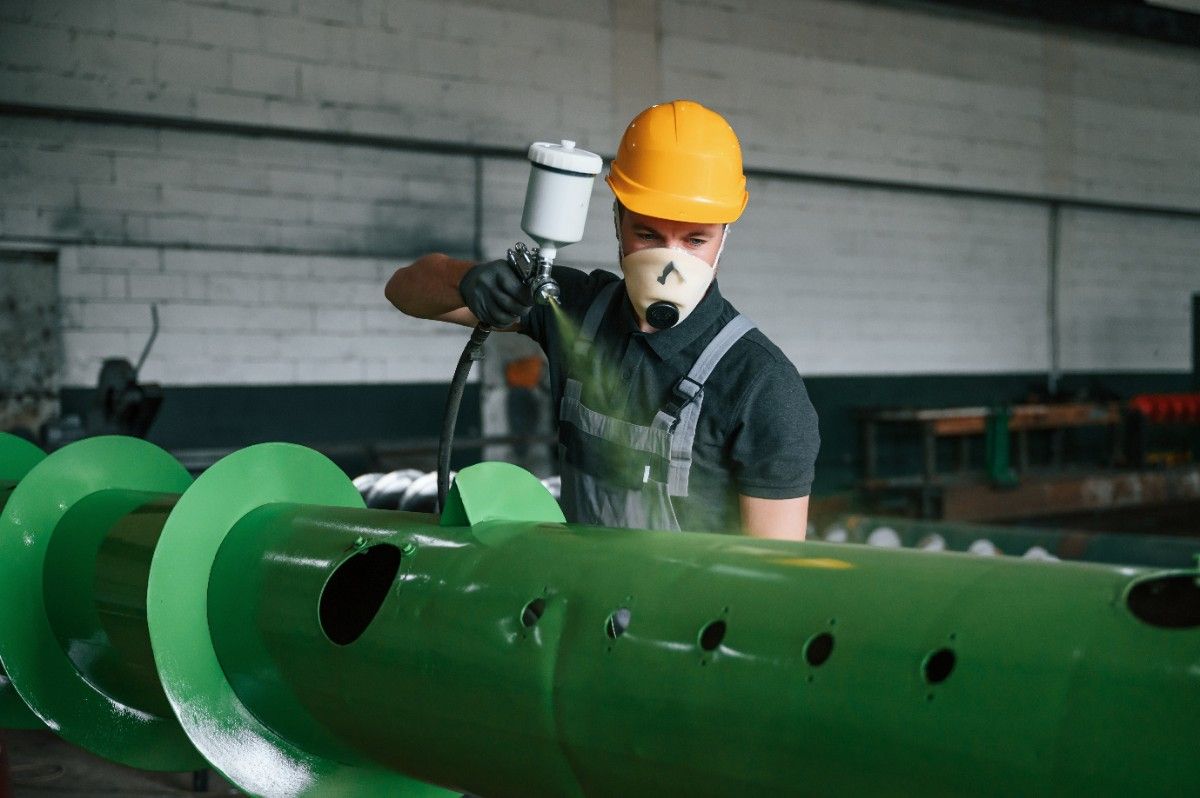
Summary: Fusion bonded epoxy is a thermoset powder coating that melts onto heated, blasted steel and cures into a hard, bonded corrosion barrier. It is the standard external coating for buried pipelines because it adheres tightly to steel and stays compatible with cathodic protection.
A pipeline can be built to handle pressure for decades and still fail from the outside in. Moisture, soil chemistry, and handling damage attack bare steel from day one, which is why nearly every buried line ships with a coating. Fusion bonded epoxy coating is the most common choice for that job.
This guide explains what FBE is, how it is applied to pipe, how it compares to other coatings, and where it falls short. B&W Pipe supplies FBE coated pipe matched to the pipe order, so the coating and the steel come from one source.
What Is Fusion Bonded Epoxy Coating?
Fusion bonded epoxy is a thermoset epoxy powder that is applied to preheated steel. The powder melts on contact, flows into a continuous film, and cures through a chemical reaction that cannot be reversed. Once cured, it does not soften again when heated, which is what “thermoset” means.
The “fusion bonded” part describes how it attaches. The bond forms from heat and chemistry directly on the steel surface. There is no solvent and no separate adhesive layer. The finished film is thin, hard, and fused to the metal rather than sitting on top of it.
An FBE coating is also a clean system. Because it is a powder, it contains no solvents, and overspray can be collected and reused.
How FBE Powder Coating Is Applied to Pipe
Application happens in a plant, not in the field. Each step affects how long the coating lasts:
- Surface preparation. The pipe is abrasive blasted to a near-white metal finish. This removes mill scale and rust and creates the surface profile the coating grips.
- Heating. The pipe is heated, typically to around 450°F, so the powder melts the moment it lands.
- Powder application. The FBE powder coating is sprayed electrostatically. The charged powder is drawn to the grounded pipe and covers it evenly.
- Curing. The powder melts, gels, and cures into a continuous film within seconds to minutes, depending on the formulation.
- Quench and inspection. The pipe is cooled with water, then checked for film thickness and holidays, which are tiny gaps in the coating.
Surface preparation deserves special attention. A coating can only be as good as the surface under it. Poor blasting or contamination causes more FBE failures than the coating chemistry does.
Key Properties of FBE Coating
| Property | What It Means on a Pipeline |
|---|---|
| Strong Adhesion | The film stays bonded through handling, transport, and soil movement |
| Cathodic Protection Compatibility | Does not shield CP current, so the two systems work together |
| Abrasion and Chemical Resistance | Holds up to soil contact and many soil chemicals |
| Thin, Uniform Film | Typical single-layer thickness of 12–16 mils (300–400 microns) |
| Solvent-Free | Cleaner application with less waste |
Of these, cathodic protection compatibility is the property that matters most. Most buried oil and gas pipelines rely on cathodic protection as a second layer of defense. A coating that blocks that current weakens the whole system. Fusion bonded epoxy lets the current reach any small defect, which is where it is needed.
Where Fusion Bonded Epoxy Pipe Coating Is Used
Fusion bonded epoxy pipe coating shows up wherever steel pipe goes underground or underwater:
- Oil and gas gathering and transmission lines
- Buried and underground pipeline segments
- Water and wastewater pipelines
- Directional drill and bore crossings, usually with an abrasion-resistant version
It is especially common on gathering systems, where long buried runs make coating failure expensive to repair.
Standards That Govern FBE Pipe Coating
Two standards cover most FBE specifications:
- ISO 21809-2 covers external FBE coatings on pipelines in the oil and gas industry.
- AWWA C213 covers FBE coatings on steel water pipe.
These standards define surface preparation, film thickness, and testing. A specifier can name one reference instead of writing a custom coating spec, and every coating plant knows what is required.
FBE vs. Other Pipe Coatings
FBE is the standard choice, but it is not the only one. Here is how it compares:
| Coating | Cathodic Protection Compatible | Typical Use | Where It Is Favored |
|---|---|---|---|
| FBE | Yes | Oil and gas, water pipelines | Standard choice for buried CP-protected lines |
| Polyethylene (PE) | Limited | Water, gas distribution | Heavier mechanical and impact protection |
| Coal Tar Enamel | Yes | Older buried pipelines | Legacy underground systems, being phased out |
| Polyurethane | Yes | Marine, high-abrasion service | Rocky soil, rough handling environments |
Some projects use dual-layer FBE, which adds an abrasion-resistant outer layer over the base coat. It suits rocky backfill and directional drilling, where a single layer could be gouged during installation.
For a broader look at every coating type, see our Pipe Coating guide.
Limitations of FBE Coating
Knowing where FBE struggles helps match it to the job:
- Impact and gouge resistance. Single-layer FBE is thinner than polyethylene systems, so it tolerates less rough handling.
- UV exposure. Prolonged sunlight degrades the surface. Pipe stored outdoors for long periods should be covered.
- Field joints. The factory coating stops at the pipe ends. The weld area needs a compatible field-applied coating after joining.
- Temperature. Standard FBE has a service temperature ceiling, so very hot lines may need a specialized formulation.
None of these rule FBE out. They explain why the coating choice should follow the conditions, not habit.
How to Choose a Coating System
Work through these questions before specifying a coating:
- Will the pipe be buried or exposed? Burial favors FBE. Long exposure calls for UV protection.
- What are the soil and handling conditions? Rocky backfill or drilled crossings may call for dual-layer FBE or a heavier system.
- Is cathodic protection planned? If yes, a CP-compatible coating such as FBE is the safer choice.
- What is the operating temperature? Confirm it falls within the coating’s rated range.
- Which standard governs the project? ISO 21809-2 for oil and gas, AWWA C213 for water.
- What is the budget? FBE usually costs less than multi-layer systems and more than bare pipe, and it saves far more over the life of the line.
How B&W Pipe Supports FBE Coated Pipe Projects
B&W Pipe supplies pipe with FBE and other O.D. coatings as a combined offering, coordinated at the point of order. You do not manage two vendors and two shipments.
-
Wide pipe compatibility
FBE is available across ERW/HFW, DSAW, SMLS, and Rolled & Welded pipe.
-
Complete protection
Field joint material and internal linings are available alongside the exterior coating.
-
Documentation
Mill Test Reports travel with the base pipe, and coating certification is included with every order.
-
Regional supply
Inventory and coating support run through Katy, Houston (Patriot Pipe Services), and New Braunfels.
For specifications, ordering steps, and current inventory, see our FBE Coated Pipe for Oil and Gas Applications page.
Frequently Asked Questions
Q.1 What is fusion bonded epoxy used for?
Fusion bonded epoxy protects steel pipe from corrosion in buried, submerged, and exposed service. It is most common on oil and gas gathering and transmission lines and on water and wastewater pipelines.
Q.2 How does FBE coating work on steel pipe?
Heated, blasted steel is sprayed with epoxy powder. The powder melts, flows, and cures into a hard film fused to the metal. That film seals out the moisture and oxygen that cause corrosion.
Q.3 Is FBE coating compatible with cathodic protection?
Yes. FBE does not block cathodic protection current, which is one of the main reasons it is the standard coating for buried pipelines that use CP.
Q.4 How thick is FBE pipe coating?
A standard single-layer FBE coating runs about 12 to 16 mils, or 300 to 400 microns. Dual-layer systems are thicker.
Q.5 What is the difference between FBE and polyethylene coating?
FBE is a thin, hard epoxy layer fused directly to the steel and fully compatible with cathodic protection. Polyethylene is a thicker mechanical barrier with more impact resistance but more limited CP compatibility.
Q.6 Can FBE coated pipe be used above ground?
It can, but prolonged sunlight degrades the surface over time. Above-ground service usually calls for a UV-protective topcoat or a different coating.

Patrick Boatright is the President of B&W Pipe Inc., a leading supplier of carbon steel and API line pipe solutions serving the energy, utility, and infrastructure industries across the United States. A graduate of Southwestern University, Patrick brings decades of experience in the pipe and steel industry and has built a reputation for reliability, product knowledge, and delivering high-quality pipe solutions for projects of all sizes. Under his leadership, B&W Pipe has become known for its extensive inventory, hard-to-find products, and commitment to customer service. Patrick specializes in API 5L line pipe, structural pipe, and custom sourcing solutions tailored to the demands of the oil, gas, waterworks, and industrial sectors.